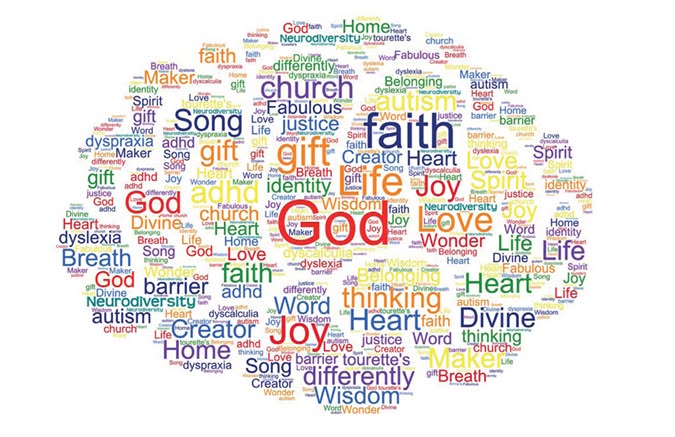
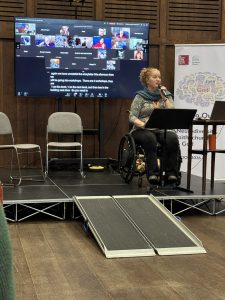
Last weekend was the fifteenth annual Inclusive Church / St Martin in the Fields Disability Conference. This year the theme was ‘Loving Our Own Minds: Neurodiversity, faith, church and God’. I first attended this conference in 2019, which was also a focus on neurodiversity. That year I was a storyteller – the video is here. Since then, I have been part of the planning team, especially during lockdown years when we took it all online. Last year I wasn’t well enough to attend, but this year I was delighted to be there, back on site – whilst also online, for a fully hybrid conference. During our online years we have developed regulars joining us from Canada and New Zealand, and others joining us from bed or with other limited mobility or distance which makes presence in London challenging or impossible. It was fabulous having people contribute in the building from zoom, and seeing all the zoom participants behind the speaker on the platform.
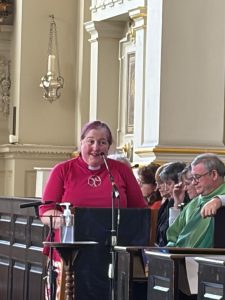
On the Sunday morning, it was an honour to read one of the readings during the Sunday Eucharist, as a member of the conference planning team.
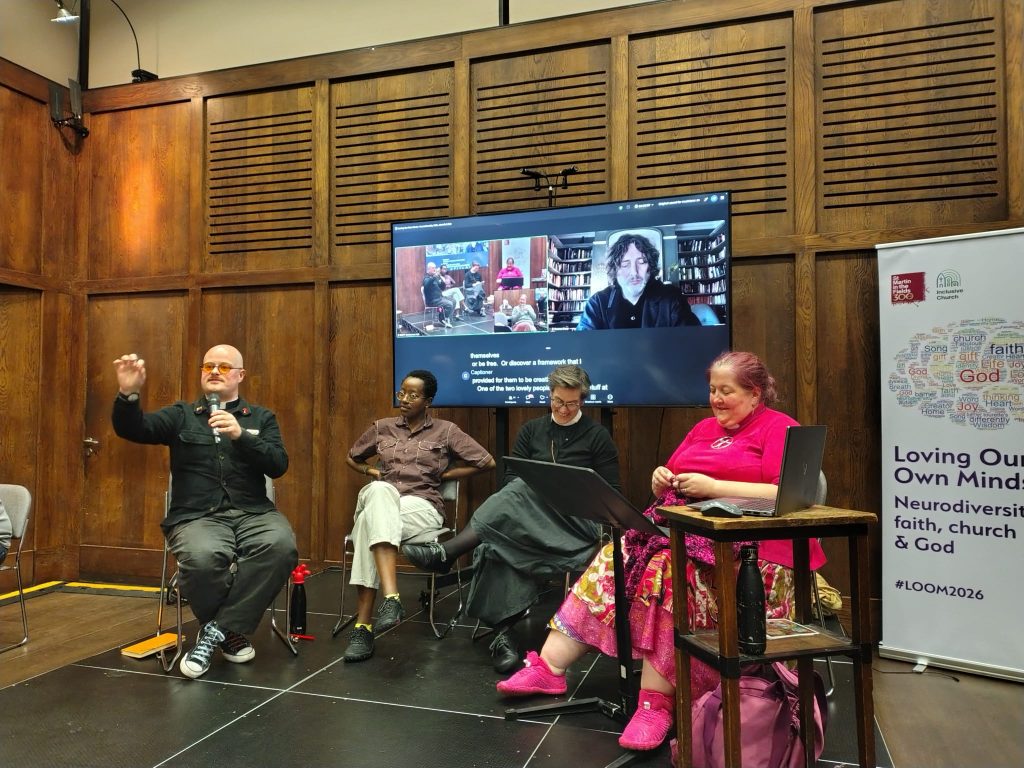
In the afternoon it was a fabulous neurodiversity and creativity afternoon. The awesome Ayla Lepine shared the process of writing her forthcoming book, Women, Art & God. And then there was a panel of neurodivergent creatives, which I participated in. I share the initial questions and answers that I gave as part of this panel.
Q1
Introduce yourselves and share one thing you’d like people to know about neurodivergence & creativity.
Hello, I’m Rachel Noel, the pink vicar from Bournemouth / an Anglican priest.
I’m openly autistic, ADHD & bipolar, diagnosed late – as is true for many women. For me, it was all around my 42nd birthday, my own answers to life, the universe and everything – a very Douglas Adam’s birthday. All the diagnoses identified in the same week… that was quite a week… and a very interesting email to bishops & HR…
Around diagnosis, I remember looking at myself in the bathroom mirror and smiling at myself for the first time ever – because I finally knew the person looking back, the person I had always been.
The one thing I’d like people to know about neurodiversity and creativity is that they are fundamentally linked together.
Back in 2017, when my diagnoses were new and shiny, and I was trying process them, to understand what they meant for me, I remember getting really disheartened by every conversation I had with a psychiatrist – all of it from a deficit model.
I remember taking my Dad’s cousin Richard (like Dad to me since my Dad died 20 years ago). I took Richard with me to a second opinion appointment with a London psychiatrist.
In this particular conversation, the psychiatrist described various characteristics of mine
- my high energy
- My enthusiasm and spontaneity
- My love of bright colours, especially pink
- My creativityq
- My quick-thinking
- My pattern-matching
These are the sort of things that feature in every reference about me, these are some of my strengths.
My jaw hit the floor when the psychiatrist explained that these were some of my symptoms, and not only that, they were my symptoms that should be medicated to reduce risk – bipolar especially seen almost entirely through the lenses of fear and risk.
Language is so important – and although I disagreed with the psychiatrist on pretty much everything- and I do not take the medication he thought I should take to reduce risk.. to reduce my symptoms… to reduce my creativity…to reduce me.
It was that conversation with the psychiatrist when I knew that my creativity was my neurodiversity, my neurodiversity was my creativity – they can’t be separated in me.
I meant to ask Google for a definition of creative, to which the answer is
Creative as an adjective is having the power or skill to bring something new, imaginative or original into being.
But what I actually asked Google for was a creative definition of creative.
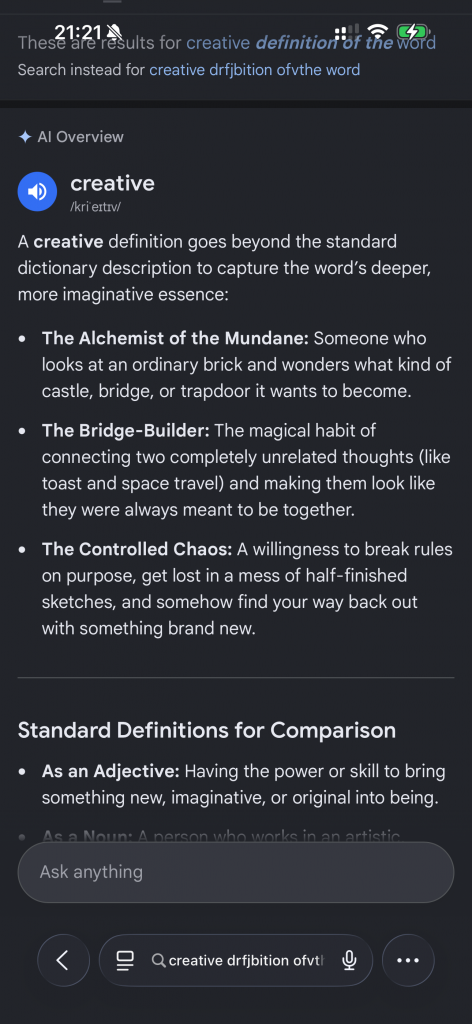
It answered that a creative definition goes beyond the standard dictionary description to capture the word’s deeper, more imaginative essence –
It gave three examples
The Alchemist of the Mundane – someone who looks at an ordinary brick and wonders what kind of castle, bridge or trapdoor it waits to become.
The Bridge Builder – the magical habit of connecting two completely unrelated thoughts (like toast and space travel) and making them look like they were always meant to be together.
The Controlled Chaos – a willingness to break rules on purpose, get lost in a mess of half-finished sketches and somehow find your way back out with something brand new.
All three creative definitions of creative also seem to be descriptions of some of the manifestations of neurodiversity, ADHD in particular.
So my one thing about neurodiversity and creativity, via a roundabout adhd story, is that neurodiversity and creativity are intrinsically linked.
Q2
You are known as the pink vicar. How do you think your neurodivergence affects your creativity and how does this connect with your faith and vocation.
I’m going to answer this by telling you the story of pink and me.
This was back in 2004/5, 22 years ago. I had had a miscarriage on Christmas Day the year before, and I had been present a couple of months later with a very good friend when her baby died the day he was born.
I was really struggling with grief.
I phoned a local convent, I was 30. I arranged to go on a Silent retreat.
The nun who was my guide asked me to choose an image of Jesus to pray with, from a variety of images that she showed me.
There was one in particular that I really reacted against
In a very autistic way, I now understand
It was just wrong.
She asked me to take the image away into the silence, to work out what I was reacting against.
Alexithymia is very real, the challenge to name feelings and emotions.
Eventually I worked out what was wrong with the image – it was a postcard of an icon – Christ Pantocrator
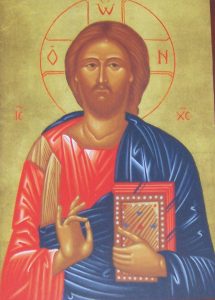
And Jesus was wearing red.
That was what was wrong.
Jesus… wearing red.
I had to sit with that for a while…. What was wrong with Jesus… red…
Well, it turned out that my colour for God was gold…
Holy, remote, awesome, wonder, definitely other, transcendent.
So what was red to me – passion, fire, spirit, anger, energy, movement, dynamism, desire…
Could these really be colours for God too?
I re-read the gospels, all of them…very autistic, I needed to see the data myself… looking for evidence – and it’s all there.
Jesus is passionate, he gets angry, he is dynamic, he is filled with spirit.
And I started to let this colour be real for God too.
As I prayed with that image, that icon of Jesus, that red… what did praying for a red God do to me?
Well, the colour I had for me was blue. Up until that season, you would only ever see me wearing black, blue, white, maybe a hint of burgundy. Even my wedding dress was navy blue.
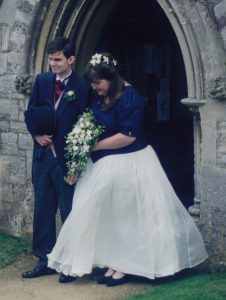
What happened to blue me as I prayed with a red God, and not just a white / gold God.
That colour seeped in to me. The blue became purple… the purple became pink… made in the image of God, being transformed through God’s love, becoming more Christ-like.
And being quite a literal autistic me
Blue me was very visible before, wearing blue all the time – but that didn’t stand out.
Pink me… is also very visible…but pink is noticeable in a way that blue was not.
11 years later, by which time I had been ordained, the local newspaper started to call me the pink vicar… and the name stuck. My website is now thepinkvicar.com
I started to wonder if the pink had become a brand… was it still a symbol of God’s transforming love … or was I starting to hide behind it.
So in 2016, I gave up pink for Lent. (But without spending money to replace pink things). (If you want to read the blog posts, they start here:)
I’m pretty sure that lent was extra long that year
It was so hard.
I had to do washing a lot more regularly, which is a challenge for adhd me, because most of my clothes are pink.
Wittgenstein said – ‘a picture held us captive’. And I needed to test it out… had I been held captive by pink?
Through that Lent, and still true now, was the realisation that pink really is an expression of who I am at the moment
A person
A work in progress… in process
Being I haven’t noticed the time what it like I didn’t know at the time about the autistic stuff but my whole kind of reaction to colour. Is it really autistic reaction to me? Just being wrong and taking a while to identify what it is and my whole living out of pink again is yeah transformed by God’s love.
I typically use colour to help me to pray – to help me to identify what I am feeling and to offer it to God
I was recently at a talk by trans priest Sarah Young. She shared a quote, although I don’t know its origin. She said
‘Who you are is God’s gift to you
What you do with that is your gift to God.’
Using the creative nature I have been blessed with is part of my gift to God.
To live authentically as me, pink me.
I wrote my MA dissertation on creative process and theological reflection. Creative process is how I do theology, it’s how I engage in prayer. It’s often messy, it’s externalising the inner workings of my mind.
Sometimes I let those messy creative beginnings grow into a piece of art – be it stickers textiles, paintings or sculpture.
For those of you onsite, my gift to you is some art postcards – feel free to pick one of each at the end of this panel. For those joining online, I have shared the images in the loving our own minds Facebook group. You can also find them on my website thepinkvicar.com
The images I shared are
The Lord’s Prayer – this is a video of the creation of this painting during a 24 hour diocesan quiet day in lockdown in 2020.https://www.youtube.com/watch?v=3Xn19Ujvf6I&